
Il mio carrello
Il carrello è vuoto


Italy’s tourism industry continues to expand, reinforcing its role as a key driver of the national economy. In 2026, tourist overnight stays are projected to reach 548.9 million, up 2.5% from the previous year, while the sector’s direct value added is expected to rise to €121.9 billion. Including indirect and induced effects, tourism will account for 11.3% of the Italian economy.
These are among the main findings of SRM’s fourth report, Tourism, Enterprises & Territory 2026, which examines the sector’s evolving dynamics through the lenses of competitiveness, technological innovation, and emerging market trends.
Despite a global environment marked by economic uncertainty, geopolitical tensions, and rising travel costs, tourism continues to demonstrate remarkable resilience.
Italy remains one of Europe’s most competitive tourism destinations at the regional level. According to SRM’s Regional Tourism Competitiveness Index (ICTR), 19 Italian regions rank among the top 50 out of 98 regions assessed across Italy, Spain, France, and Germany. Veneto leads the ranking, while Campania, Sardinia, and Apulia stand out among Southern Italian regions.
A survey conducted among 1,000 hotel businesses highlights a sector that continues to invest in its future. Around two-thirds of establishments have made investments over the past three years, primarily in property renovations, refurbishment projects, and service upgrades.
Looking ahead, the main priorities include energy and water efficiency, environmental sustainability, and staff training. The findings also show that businesses investing more actively tend to achieve stronger economic performance, confirming the close link between innovation and competitiveness.
Artificial Intelligence is rapidly becoming part of hospitality business strategies. 37.1% of companies have already invested, or plan to invest, in AI solutions between 2026 and 2027, while nearly one-quarter are currently evaluating potential applications.
The most common uses involve customer service, marketing, sales, and revenue management. Chatbots, personalized offers, review analysis, and automated guest interactions are becoming increasingly widespread. At the same time, challenges remain regarding costs, skills availability, and the integration of new technologies into existing business processes.
As technology gains importance, human capital continues to be a crucial element in delivering high-quality tourism experiences.
In 2025, the sector employed an average of 1.596 million workers, exceeding both pre-pandemic levels and the previous year’s figures. At the same time, businesses report growing difficulties in recruiting qualified personnel, particularly in hospitality, food services, and entertainment activities.
As a result, continuous training, professional development, and investment in interpersonal and problem-solving skills are becoming increasingly strategic for the sector’s future growth.
The SRM Report portrays a tourism industry in good health, supported by international demand and a strong propensity to invest. The key challenge for the coming years, however, will be transforming rising visitor numbers into greater economic value for businesses and local communities.
Innovation, sustainability, and skills development will be the pillars of Italy’s future tourism competitiveness, helping the sector evolve toward more resilient, higher-quality, and long-term growth models.


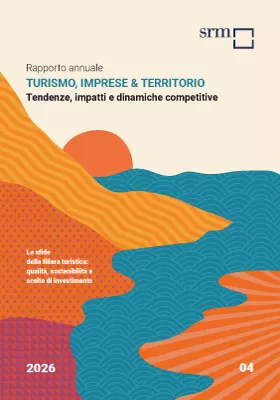

The SRM Tourism Observatory reaches its fourth edition and examines the evolution of Italian tourism in a context marked by growing international travel flows, technological innovation, and new competitive challenges. Through data, forecasts, and in-depth analyses of businesses, investments, human capital, and Artificial Intelligence, the report highlights the strategic drivers that can strengthen destination competitiveness and turn tourism into a catalyst for economic and territorial development, with a particular focus on Southern Italy.


© Copyright 2021- SRM - Centro Studi e Ricerche - P.iva 04514401217
© Copyright 2021- SRM services - P.Iva/C.F.: 09117291212 - Privacy Policy
Powered by


Ti stiamo reindirizzando su
